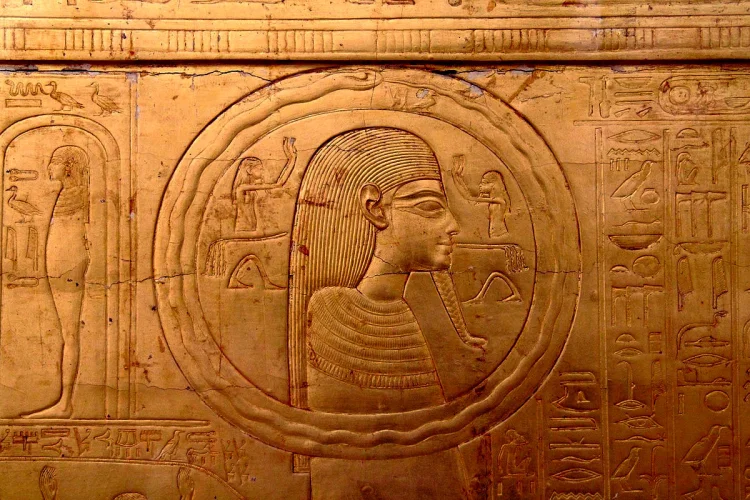
The sarcophagus of Tutankhamun [1,300 BCE]. Note the coiled snake at the center trying, but failing to swallow its tail.
Ourobouros [Classical Greek; literally: ‘Tail-Eater’], the earliest allegorical symbol in Alchemy with its origins in early Egypt and Greece marking the summum bonum of Immortality. The ‘Cycle of Birth and Death’. The Binary that makes us pause.
Ourobouros; in our lexicon, the ‘The Self-Eating Expression’.
Tát, literally ‘That’ [Tát Tvam Asi; Aum Tát Sat et al], is an overarching expression that goes back to the first Vedic Texts.
‘That’, the briefest possible assertion is an ‘Expression of Inexpressibility’. It is an immediate, unregenerate contradiction, grammatically homeless, a lexicographer’s nightmare, and meant to be so. We call these Logico-lingual terms: ‘Self-Eating Expressions’ [‘SEE’].
Siddhartha Gautama’s chosen name for himself was not as the ‘Buddha’, a later appellation, but as the Tát-āgathā [literally, ‘That’-Gone; or less cryptically: ‘One in view of ‘That”].
The English translation of the expression: Śūnyathā, so central to the tradition of Chan-Zen, is as: ‘That-Ness’, from Táttatha, the same ‘That’ as above.
That’ [Tát], the simples terminal Assertion, is the direct parent of the ‘Not’ [Yājñavalkya‘s Neti], the simplest terminal Negation and most likely the immediate ancestor of the Symbol ‘0’ in the Dharmic Tradition. An assertion asking for its own negation, it was the first graphic-visual rendering of the Self-Eating Expression.
The meaning of the expression Tát [‘That’] began regressing as early as as the Chandogya Upaniṣad where several verses refer to it as a: ‘Subtle Inner Essence’, the forerunner to the dominant role of an ‘Inner Self’ in later Vedantha.
It is one of the reasons that the synonym for Śūnyathā was rendered as Táttatha [‘That-ness’] an otherwise unwarranted abstraction [you cannot abstract ‘That’ except as a pedagogic convenience].
 Not-Two
You must be logged in to post a comment.