The expression Advaya (अद्वय) literally translates as ‘Not-Two’ and dates back to the first texts. When attached to a particular school it typically takes on a suffix as in the Advaitha of Hinduism or the Advayadharma of the school of Śūnyathā.
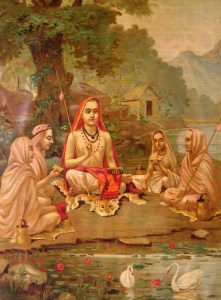
[Advaitha] Vedantha is arguably the most influential school within the vast campus of the ‘Mother-Tradition’ [Hinduism] going back 1,500 years. There are others, but none with such an illustrious, lengthy lineage.
Vedantha’s formal origins are in the Ajātivāda of Gaudapada itself drawn from the Prajna-Paramitha texts in which Gaudapada was schooled [See Post: ‘Oldest Printed Text’]. And its determining influence is evident in his opus, the Gaudapada Karika:
‘Uttama Satya [the highest truth] is …[the realization] that there is neither dissolution nor creation, neither bondage nor liberation, no one seeking liberation, no one attaining liberation.‘
Following Gaudapada, it was Śaṅkarācārya [around 700 CE] who in his famously lucid Sanskrit reformulated the Teaching for the then modern ear.
Śaṅkarā’s age saw a sharp rise in the popularity of the Buddha Dharma. And to anyone familiar with the Texts, it is certain that Śaṅkarā‘s division of Brahman into Sahguna and Nirguna-Brahman [‘Form and Formless’] had its roots in the Śūnyathā of the [‘Diamond-Cutter’] Sūtra. [Advaitha] Vedantha was in many ways the re-appropriation of a truant back into the orthodox fold of Vedic exegesis.
So it is that Śaṅkarācārya would declare in his seminal Gita Bhashya: ‘Atman is the ‘Knower of the Field’ [Kshetragnana]: the Witness of the three states of Waking, Dreaming and Sleep.’
And in his Vivekachudamani: ‘A liberated Being is one who sees himself as single and the witness…of the world of things…the substratum of all‘.
And in his: Upadesasahasri [11.7]: ‘I am other than name, form and action. My nature is ever free! I am Self, the supreme unconditioned Brahman. I am pure Awareness, always non-dual’
In the layout of Vedantha, this ‘Original Inner, Immaculate ‘Self”, this ‘Witnessing Being’, is over-laid in multiple obscuring illusory sheaths [Koshas]. And in Vendathic Teaching, to unveil this ‘True Self’ is the fulfillment of the purpose of life and the gaining of liberation.
The intuition is compelling: get rid of the Modeled-Self and awake to ‘True Self’. The problem is that this kind of interpretation still spins in the Self-Loop.
There is much that the trekker gains from Śaṅkarācārya‘s insights. But as a Schola-Monk raised in orthodoxy, he couldn’t at the final turn resist the installing of an Absolute, a Primal ‘Being’ at the sanctum sanctorum of his opus. The clean-up is incomplete.
I wince when I visit a Śaṅkarā Monastery, 1,500 years after its founding, and find bright, earnest Brahmin boys, whose role is to search for and express Brahman, perfecting instead the rounding of the rolled rice-ball.
 Not-Two
You must be logged in to post a comment.