Friedrich Hegel: ‘It is a natural assumption in philosophy, before we start to deal with its proper subject matter, viz. the actual cognition of what really is, one must first of all come to an understanding about cognition..a certain uneasiness seems justified..
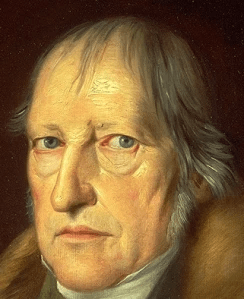
For if cognition is the instrument, [it] sets out to reshape and alter it. If [it] is not an instrument but a passive medium through which the light of Truth reaches us, then again we do not receive this Truth as it is, but only..through this medium.
Either way we employ a means which immediately brings about the opposite of its own end..what is really absurd is that we should make use of a means at all…‘
Hegel was acutely aware of this coasting close to the Self-Loop. There is a literature which argues that much of his later work was a recoil from this threat of outright chaos. But Hegel, like Immanuel Kant, succumbed, stopped short, found Religion and turned back at the cliff’s edge.
Hegel rewrote his intuition of the Self-Eating Expression into the more manageable trinity: ‘Thesis, Anti-Thesis, Synthesis’ and its variants [a structure that Hegel actually credited to Kant]. From Marx and Mao to Derrida and ‘Deconstructionism’, intellectuals saw explanation here. The rest as they say is history.
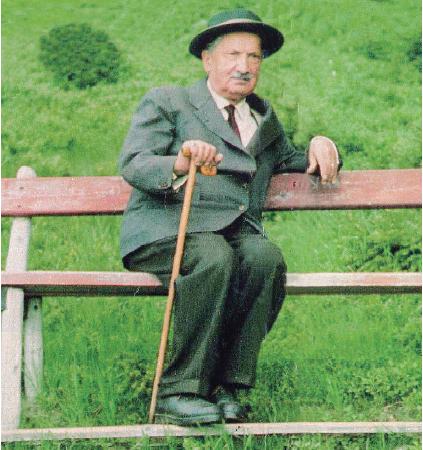
1889-1976
Martin Heidegger’s roots were in Phenomenology, from Phainomenon, ‘what shows itself in itself’.
And he was a dominant influence on Academic Philosophy and high cafe- speculation for most of the last century. [I’ll take Les Deux Magots over a library any sunny day.]
Here is Martin Heidegger:
‘The indefinability of Being does not dispense with the question of its meaning but forces it upon us. Being..is the self-evident concept..in all our knowing and predicating.
Everyone understands ‘The sky is blue’, ‘I am happy’.. but this average comprehensibility only demonstrates the incomprehensibility. An enigma lies a-priori..
We do not know what Being means but already when we ask: ‘What is Being?’, we stand in an understanding of the ‘is’ without being able to determine conceptually what the ‘is’ means..‘
Heidegger circled in the vicinity and was increasingly alert to the issues of Two-ness. But in this new unfamiliar terrain he had to invent a whole new terminology which looped Language to its limits [‘the possibility whose probability it is solely to be possible’].
I knew an artist once in New York’s Greenwich Village who disliked books and was utterly dismissive of all philosophical rant. But he always kept a hard-cover edition of Heidegger’s 600 Page tome :‘Being and Time’, prominently displayed on his Naguchi coffee-table. The Language, and with it Heidegger, had taken on their own mystique.
 Not-Two
You must be logged in to post a comment.