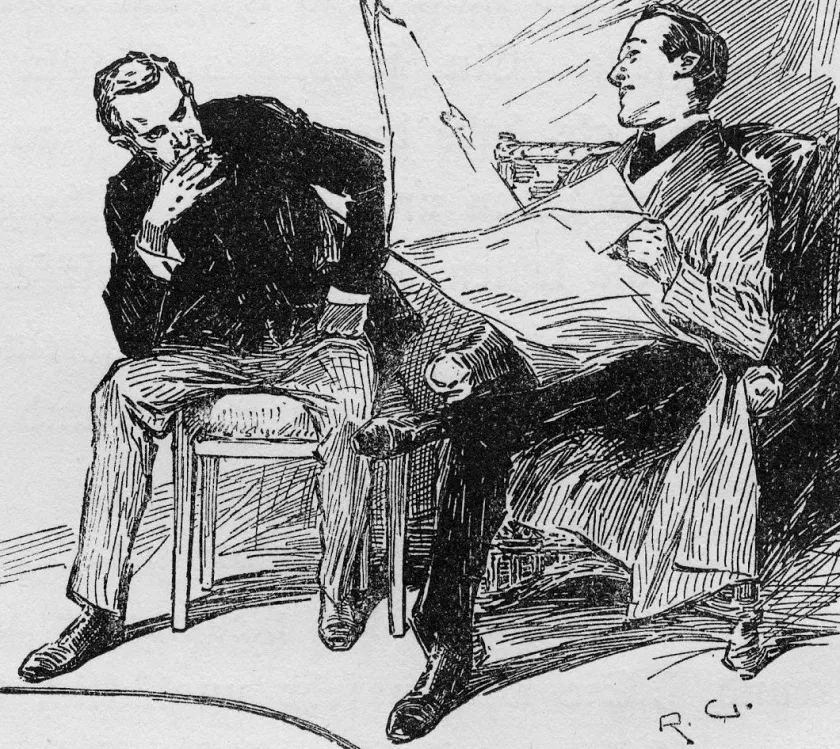
‘How often have I said to you [Watson], that when you have eliminated the impossible, whatever remains, however improbable, must be the truth’.
Arthur Conan-Doyle: ‘The Sign of Four’ [1890]
'This Unformulated Principle'
‘How often have I said to you [Watson], that when you have eliminated the impossible, whatever remains, however improbable, must be the truth’.
Arthur Conan-Doyle: ‘The Sign of Four’ [1890]
Methods of Inquiry that have immediate credibility to the modern-ear begin with the early Greek philosophers.
Inquiry must begin, they said, with the assertion of Axiom, the investigative analogue of the atom. [You can’t prove an Axiom. Bad idea. The idea of ‘proof’ itself is rooted in an Axiom. But people try all the time.] But in most cases we have to settle for the Assumption. In a fogged-in world it is the reasonable man’s truth.
Unlike its ancestor the Monastery where Meditation Practice involved sustained inquiry into assumptions, every subject taught at a Modern University begins with implicit, mostly unstated assumptions called ‘First Principles’.
Every known ‘First Principle’, in Philosophy, in Logic, in Language, in Science, is granted legitimacy, takes life, atop the Binary-Platform, the ‘First Presumption’ that there is an ‘Independent [hence separated] Inquirer’.
These range from the thoughtful to the fearlessly flippant. The professors, busy folks, are unlikely to remember what they are. Ask the lady at the front-desk for the ‘First Principles List’. And wreck her day.
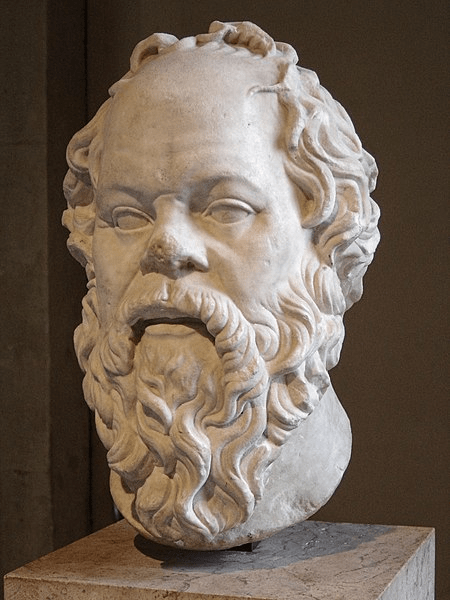
In the best known lines from Plato’s Phaedrus:
‘But I [Socrates] have no leisure for them [other inquiries] at all.
And the reason, my friend, is this: I am not yet able, as the Delphic inscription [Gnothi Seauton] has it, to know myself; so it seems to me ridiculous, when I do not yet know that, to investigate irrelevant things.‘
University, from the Latin: Universus, ‘Whole’.
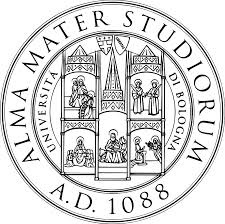
Did you know that by most reliable accounts the world’s oldest University still giving courses is Bologna, founded in 1088 C.E.?
And that it originated in the monastic schools that had been active for nearly 400 years until the University was established? No? And you have a degree from Oxford [1167 C.E.]?
Now what did monks in the 11th century do when not making fine brandies? Monks meditate. Navel-Gaze. Go ‘Inward’.
Now when was the last time your Philosophy Professor suggested a moment’s quiet before discussing Heidegger on the ‘Meaning of Meaning’? Ten minutes of Formal Meditation preceding John Rawls?
You can do a Doctorate in Philosophy today in the best Universities without ever raising the question of the ‘Subject’ doing the Inquiry.
If you suggest that it may be relevant, the Professor will likely take you aside and suggest that you might be better suited for Art History.
The word ‘University’ is a very specific term for an institution that birthed in the Western historical and religious tradition. There were Institutions of Learning that predated the specific concept of the University, Nalanda or Takshasheela for example, but they are not to be called ‘Universities’.
And the first and fundamental presumption of Formal Inquiry is the accepted convention, the unstated conviction, of the presence of an inquiring Subject ‘Independent’ [hence separate] from the investigated Object.
It is meaningless to talk of ‘Inquiry’ if the Subject is conjoined with the Object of Inquiry. But then, the word ‘Meaning’ itself is predicated on the presence of a ‘Me’.
As before, the issue is the cardinal claim of ‘Independence’. It is nearly impossible to find a zero-correlation [i.e ‘Independent’] state in Nature. But we begin all Inquiry by claiming this majestic status for ourselves.
We can spend decades testing an academic assumption that underpins a trite theory. But skip out on testing this first presumption that precedes the posit of Theory itself.
If you decide to proceed with the Inquiry, I’ll add a second [among several] which you might find helpful further down.
The Tradition of Formal Inquiry declares that among equally valid explanations and outcomes, the one with the least assumptions wins: Entia non sunt multiplicanda praeter necessitatem.
And he who needs the additional assumptions gets to defend them. The burden of proof rests with the claimant. But we shall not quibble. And we shall not whine.
[This has numerous variants: Falsifiability, ‘Russell’s Teapot’, ‘Occam’s Razor’ and so on, much of it relevant to investigating the wild religious claims of visiting overnight prophets and gurus.]
‘Although the Theory of Relativity makes the greatest demands on the ability of abstract thought, still it permits the traditional requirement of Science, as it permits a division of the world into Subject and Object and hence a clear formulation of the Laws of Causality. This is the very point at which the difficulties of the Quantum Theory begin’.
Elsewhere, on the method of proper observation, Heisenberg writes: ‘What we observe is not Nature in itself but Nature exposed to our method of questioning’. Try and hold on to that insight as you read the Posts.
Werner Karl Heisenberg [1901-1976]
Nobel, Physics, 1932
The Self-Eating Expression is the universal phrasing for the intuition of Not-Two in the vocabulary of the speaker. It is a summary-term put-forth by pioneering inquirers when finally confronting ‘The Wall’ of Not-Two.
The Tao
From the opening line of the opening verse of Chinese classic, Lao Tzu’s, Tao Te Ching [Circa 5th Century BCE], the first philosophy of China:
‘The True Tao is nameless; what is named is not the True Tao. The True Tao cannot be told; what is told is not the True Tao’.
Name the Tao, and what you have named, by that very fact, is not the Tao. Talk about the Tao and what you are talking about is not the Tao. The Tao is a ‘ Self-Eating Expression‘.
But this didn’t stop Lao Tzu from writing his seminal classic the Tao Te Ching which names and talks all about the Tao [sort of like this Site].
’Taoism’s instructs all men to live in Wie Wu Wei: ‘Doing Not-Doing’. The Bhagavad Gita exhorts the man to: ‘Active-Inaction’. Or as the Chinese Taoists [Hsi-tz’u] declared, it is: ‘Where Yin and Yang do not penetrate [we call it the Numinous]’.
The Buddha-Dharma
The opening Koan from the venerated Mumonkon Collection is: ‘Joshu’s Mu!’, held through history as the most powerful of all Zen-Koans.
‘Joshu’s Mu!’ is a negative particle, a vociferous assertion of negation. A fiery, full-blast ‘Self-Eating Expression‘.
An early condition for the seminal Buddhist expression Śūnyathā was as Śūnyathāsūnyathā, the ‘Emptiness of Emptiness Itself’. Corral Emptiness and what you have corralled, by that very fact is not Emptiness. The earliest definition of Śūnyathā was as ‘This Unformulated Principle’ [Front Page] before it diluted into various ‘Doctrines Of Codependence.
[The term ‘Emptiness’ was borrowed from the translated English vocabulary of Classical Logic [See Post]. ‘Emptiness’ has nothing to do with imaginary spaces of vast blankness, a common miscue in modern Sanghas.]
The Dharma
Upanishad is Rahasya: a ‘Secret Transmission’, not to be passed-on to the unprepared. Sanskrit sacred text expands from an unsaid center in concentric circles of ferociously absurd verse softening to increasing sensibility.
At the peak of Vedic intent, Brahman is Nirguna Brahman (without attributes; you cannot express something with no attributes. As Sahguna Brahman, (with attributes) all names are unabashed contradictions: Being-Becoming; Sonant-Silent; Eternal-Temporal; Explicit-Implicit, and so on. In our terminology, Self-Eating Expressions.
According to the Kanchi Paramacharya [1894-1994], holder of the lineage-seat and an authority on the subject, ‘The Nameless’ is the original name for the wider umbrella of Schools and Faiths that is known as ‘Hinduism’. Is the word: ‘Nameless’ a name or not a name? It is neither; it is a ‘Self-Eating Expression‘.
Islam
The Aramaic Alaha, the language that Jesus spoke, is in turn related to the Arabic Allah: ‘The God’, and the Hebrew: Eloah [Elohim, Elohai]. It was originally a loose reference to a regional deity and in-time appropriated into emerging Islam.
The opening line of the principle prayer of Islam, the Shahadah reads: ‘La Ilaha il al-Lah’: ‘There is no God if it be not the God’.
‘La Ilaha il al-lah’, is an informed rendering of insight as ‘Self-Eating Expression‘ meant for the trained ear and in the language of the day. In High-Sufism [Islamic Mysticism] the final stage of practice is termed Fana al-Fana, the ‘Annihilation of Annihilation itself’. A ‘Self-Eating Expression‘; naturally, necessarily.
Aristotle’s ‘God’
Aristotle formulated hugely influential models of reality [they lasted well past Copernicus; Immanuel Kant begins with him]. But oddly enough, Aristotle installed a strange character at the sanctum-sanctorum of his precise modeled world.
From Aristotle’s Metaphysics: ‘There is therefore also an Unmoved-Mover, being eternal, primary and in act..the first mover is a necessary Being..and is thus a first principle, for there is always a mover of things moved, and the first mover is itself unmoved.’ Aristotle’s celebrated: ‘Unmoved-Mover’. A classic ‘Self-Eating Expression‘.
[See the later Post on how Aristotle uses a variant of it as his defense of the ‘Principle of Contradiction’ [in delightful irony, also called ‘The Principle of Non-Contradiction’], what he called: ‘The First Principle of all Analytic Cognition’.]
Proofs And Paradoxes
The ‘Self-Eating Expression‘ is pervasive not just in ancient texts and traditions but at the heart of modern logic and mathematics and their most celebrated Proofs and Paradoxes. We’ll get to the one’s that mark the birth of the present digital-age of Binary-Truths, the period 1930-1950 CE, in later Posts.
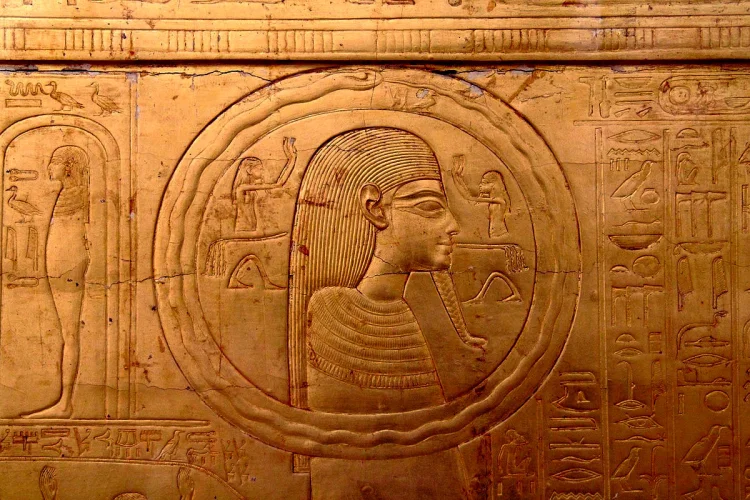
The sarcophagus of Tutankhamun [1,300 BCE]. Note the coiled snake at the center trying, but failing to swallow its tail.
Ourobouros [Classical Greek; literally: ‘Tail-Eater’], the earliest allegorical symbol in Alchemy with its origins in early Egypt and Greece marking the summum bonum of Immortality. The ‘Cycle of Birth and Death’. The Binary that makes us pause.
Ourobouros; in our lexicon, the ‘The Self-Eating Expression’.
Tát, literally ‘That’ [Tát Tvam Asi; Aum Tát Sat et al], is an overarching expression that goes back to the first Vedic Texts.
‘That’, the briefest possible assertion is an ‘Expression of Inexpressibility’. It is an immediate, unregenerate contradiction, grammatically homeless, a lexicographer’s nightmare, and meant to be so. We call these Logico-lingual terms: ‘Self-Eating Expressions’ [‘SEE’].
Siddhartha Gautama’s chosen name for himself was not as the ‘Buddha’, a later appellation, but as the Tát-āgathā [literally, ‘That’-Gone; or less cryptically: ‘One in view of ‘That”].
The English translation of the expression: Śūnyathā, so central to the tradition of Chan-Zen, is as: ‘That-Ness’, from Táttatha, the same ‘That’ as above.
That’ [Tát], the simples terminal Assertion, is the direct parent of the ‘Not’ [Yājñavalkya‘s Neti], the simplest terminal Negation and most likely the immediate ancestor of the Symbol ‘0’ in the Dharmic Tradition. An assertion asking for its own negation, it was the first graphic-visual rendering of the Self-Eating Expression.
The meaning of the expression Tát [‘That’] began regressing as early as as the Chandogya Upaniṣad where several verses refer to it as a: ‘Subtle Inner Essence’, the forerunner to the dominant role of an ‘Inner Self’ in later Vedantha.
It is one of the reasons that the synonym for Śūnyathā was rendered as Táttatha [‘That-ness’] an otherwise unwarranted abstraction [you cannot abstract ‘That’ except as a pedagogic convenience].
How does one inquire into ‘Two-ness’ when the very claim: ‘Two-ness’ mounts on the distinction of ‘Two’ [‘Two; Not-Two’].
How does one talk about the ‘Binary’? when the notion of ‘Binary’ itself is a binary division [Binary; Non-Binary’]?
How does one talk about exiting the Binary when the notions of ‘Entry and Exit’ are themselves Binary constructs?
How does one talk about a ‘Modeled-Understanding’ when the notion of ‘Model’ itself arises from a Modeled-View? [See Post on ‘Model’]
How do ‘I’ investigate ‘Me’?
The confrontation with this loopiness births the Self-Eating Expression [‘SEE’], the next Post.
Traditionally, Inquiry into Self-Referential Loops has been the preamble to actual Inquiry in the Dharmic Tradition. [See Posts; the discipline is long-lost as can be seen in the quality of contemporary Dharmic Inquiry]
In the Western Tradition you can see selective acknowledgment of this issue in such early thinkers as Heraclitus [‘Logos’] and Denys the Areopagite, more modern thinkers as Nicolas of Cusa [Docta Ignorantia; Coincidentia Oppositorum] among the Mystics, the new Quantum Physicists among the Scientists and so on.
See Friedrich Hegel on ‘The Purpose of Philosophy’ [‘Hegel To Heidegger’].
I had been around. And I had slid. From an amused bemusement, past simple bewilderment, beyond all sophisticated skepticism to a lurching unquiet desperation.
A vocal cleverness has replaced the ancient ideal of a Learned Ignorance. Scrape the surface and nothing makes sense. So I sit on the side and agree to pretend.
It takes a Genius to answer: ‘Gravity makes the Apple fall’. And a Fool to ask: ‘Why does Gravity make the apple fall?’
Isaac Newton (1642–1727) wise, died a pious Catholic seeing no quarrel here between law, origin and purpose.
What was there before the ‘Big Bang’? And where did the Monkey come from that Man descends from?
If my body temperature changes by a measly 6 degrees F, I pass out. [I’m still looking for my ‘Consciousness’ in the rest of the range.]
So is the sky out there blue? Or is it right here, the electro-chemical rinse coursing along my neurons as I look?
The visible part of the Electromagnetic Spectrum is about a third of one percent. ‘Real’ seems a dodgy idea to me if my visibility blanks out at 0.3 %. [Where did the Universe go?]
Our rules of arithmetic repeatedly fumble at the ‘Measured Speed of Light’. So what does addition mean?
‘Ask the lady in the corner office’ says the annoyed Scientist. ‘These are questions below my pay-grade. Science is not designed to answer frivolous stuff like this’.
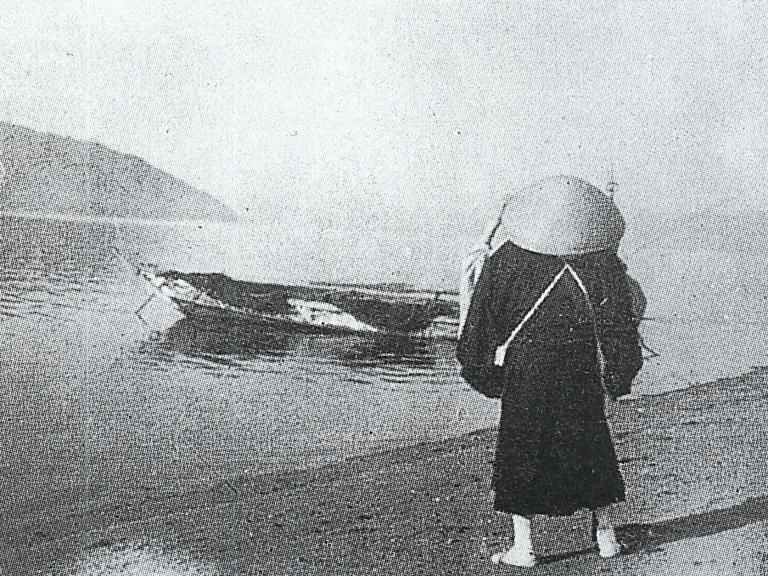
‘For forty years
I’ve been selling water
By the river-bank, Ho, Ho!
My labors have been wholly without merit’
Harada Daiun Sogaku
[1861-1971]
 Not-Two
You must be logged in to post a comment.