‘Why, all the Saints and Sages who discuss’d
Of the Two Worlds so learnedly, are thrust
Like foolish Prophets forth; their Words to Scorn
Are scatter’d, and their Mouths are stopt with Dust
Oh, come with old Khayyam, and leave the Wise
To talk; one thing is certain, that Life flies;
One thing is certain, and the Rest is Lies;
The Flower that once has blown for ever dies
Myself when young did eagerly frequent
Doctor and Saint, and heard great Argument
About it and about: but evermore
Came out by the same Door as in I went
Into this Universe, and why not knowing,
Nor whence, like Water willy-nilly flowing:
And out of it, as Wind along the Waste,
I know not whither, willy-nilly blowing
What, without asking, hither hurried whence?
And, without asking, whither hurried hence!
Another and another Cup to drown
The Memory of this Impertinence
But leave the Wise to wrangle, and with me
The Quarrel of the Universe let be:
And, in some corner of the Hubbub coucht,
Make Game of that which makes as much of Thee
‘Ah, Love! could you and I with Fate conspire,
To grasp this sorry scheme of things entire,
Would not we shatter it to bits–and then,
Re-mould it nearer to the Heart’s Desire!
The Vine had struck a Fibre; which about
It clings my Being—let the Sufi flout;
Of my Base Metal may be filed a Key,
That shall unlock the Door he howls without
And this I know: whether the one True Light,
Kindle to Love, or Wrath consume me quite,
One Glimpse of It within the Tavern caught
Better than in the Temple lost outright‘
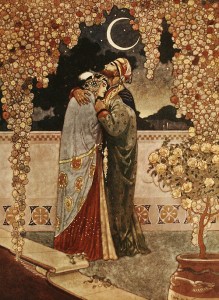
Selected verses: ‘The Rubaiyat of Omar Khayyam’
The classic and incomparable Edward Fitzgerald Translation [1859]
Omar Khayyam [Ghiyāth al-Dīn Abū al-Fatḥ ʿUmar ibn Ibrāhīm Nīsābūrī; 1048-1131 CE] is part of our extended tale. A preeminent Astronomer and Mathematician of his day, his mentor was Ibn Sena [Avicenna; 980-1037 CE] the star of the ‘Golden Age of Islam’ who was among the first to understand and amplify the ‘Hindu System of Number Representation’ as it made its way West to Venice where it found its new patrons. Fibonacci’s ‘Modus Indorum‘ is dated 1202 CE.
 Not-Two
You must be logged in to post a comment.